Update to Transgender Style Guide: Avoiding Invalidating Language Traps

trans style guide_invalidating language traps
Full image description

Today I made a third major update to The Radical Copyeditor’s Style Guide for Writing About Transgender People to add four sections on how to avoid writing or talking about trans people in ways that are invalidating or otherwise harmful. (Remember that context is everything, and that all trans people have a right to describe themselves in whatever language feels best to them.)

I also updated section 1.4 and the note that follows it to reflect better language that has emerged for instances when you want to be clear that when you say trans you aren’t referring only to trans women and men but also non-binary people, as well as the recent trend in trans communities to perceive trans and transgender as having separate meanings.

Continue reading “Update to Transgender Style Guide: Avoiding Invalidating Language Traps”
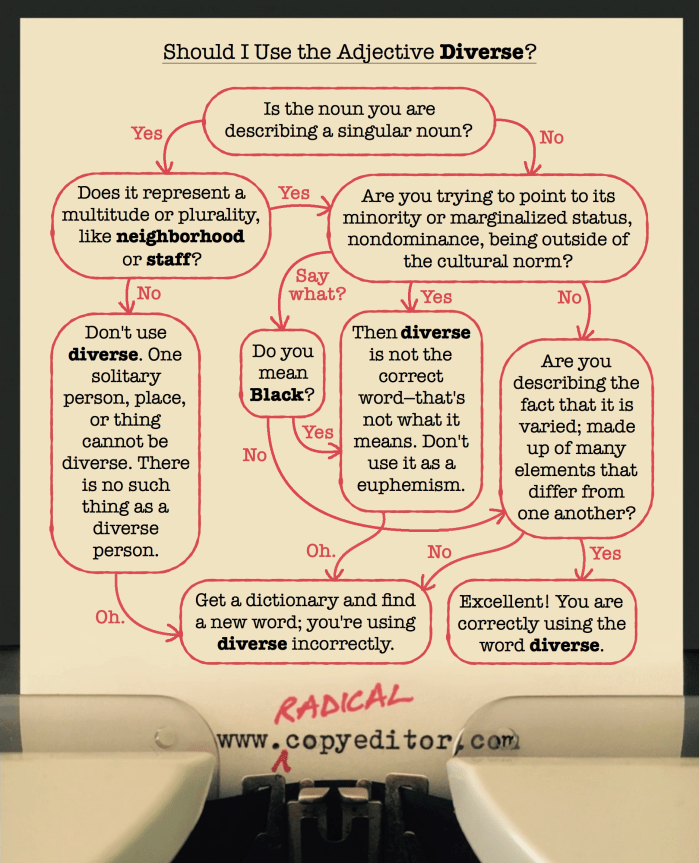
Should I Use the Adjective “Diverse”?

Flowchart titled "should I use the adjective diverse"?
Full image description

It has long been a pet peeve of mine that the word diverse is widely misused in the English language. Diverse is defined by Merriam-Webster (my favorite dictionary) as:

  1. differing from one another
  2. composed of distinct or unlike elements or qualities

Unfortunately, diverse gets misused to refer to people or things that differ not from one another, but from what is considered to be mainstream, dominant, or the cultural norm. Continue reading “Should I Use the Adjective “Diverse”?”

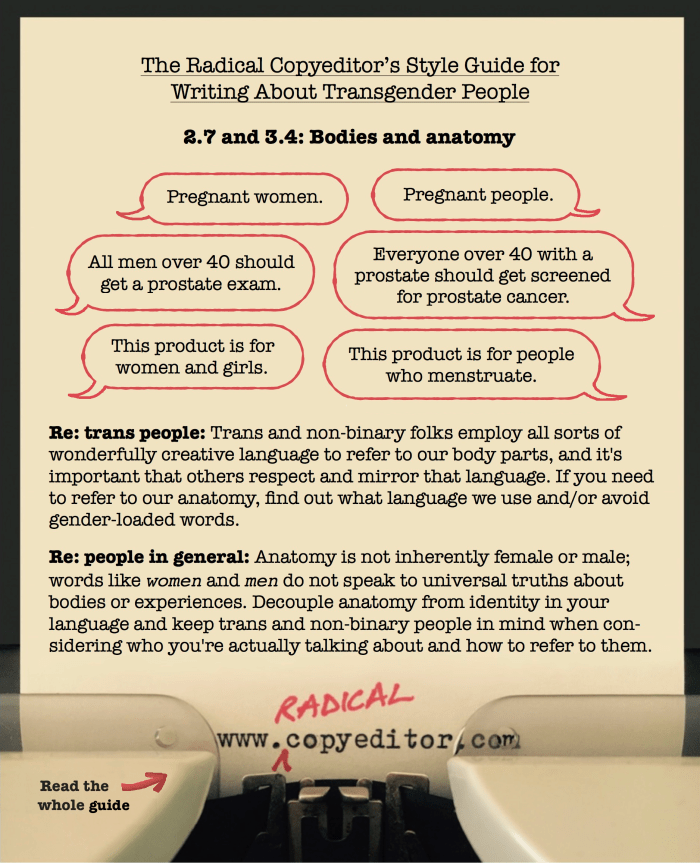
Update to Transgender Style Guide: Bodies and Anatomy

Word bubbles and text that summarize two updates to the Radical Copyeditor's Style Guide for Writing About Transgender People on the topic of bodies and anatomy
Full image description

Thanks to great feedback from readers, it quickly became clear that The Radical Copyeditor’s Style Guide for Writing About Transgender People was missing vital guidance on writing about bodies and anatomy in ways that are sensitive and inclusive.

So today I made the second major update to the style guide by adding two sections: one on practicing sensitivity around trans people’s bodies and anatomy in particular, and one on decoupling anatomy from identity when referring to people in general.

Continue reading “Update to Transgender Style Guide: Bodies and Anatomy”

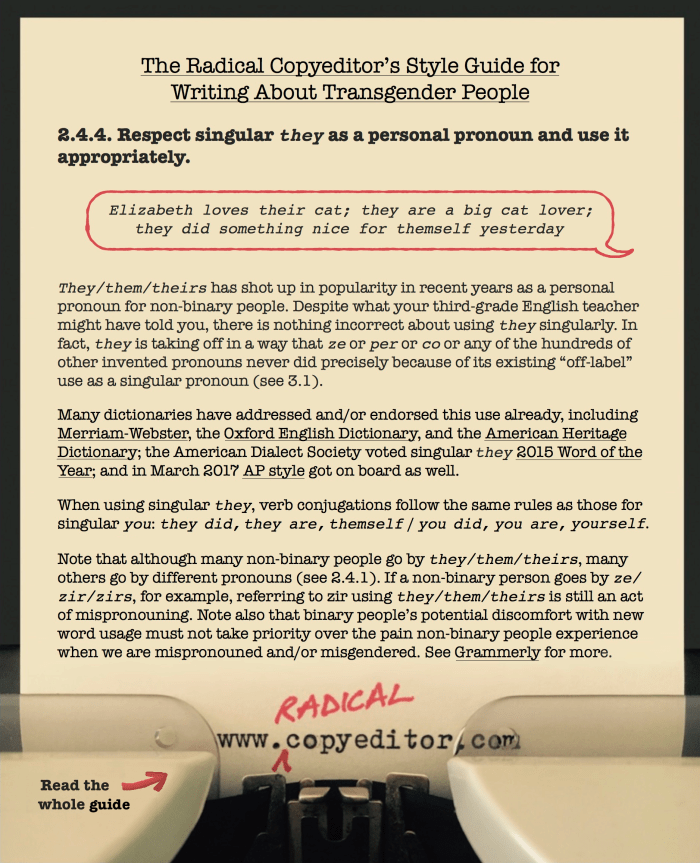
Update to Transgender Style Guide: “They” as a Personal Pronoun

A word bubble that says "Elizabeth loves their cat; they are a big cat lover; they did something nice for themself yesterday," plus the text of an update to the Radical Copyeditor's Style Guide for Writing About Transgender People (text in graphic reprinted in full below)

Thanks to great feedback from readers, I realized on Sunday that the style guide I published last week was missing a section. The guide addresses singular they as a generic pronoun for people whose gender is unknown in section 3.1, but it did not explicitly provide guidance on singular they as a personal pronoun.

Therefore, yesterday morning I added a new section: 2.4.4. Respect singular they as a personal pronoun and use it appropriately.

Click through to “The Radical Copyeditor’s Style Guide for Writing About Transgender People” to read the update in full, complete with helpful hyperlinks.

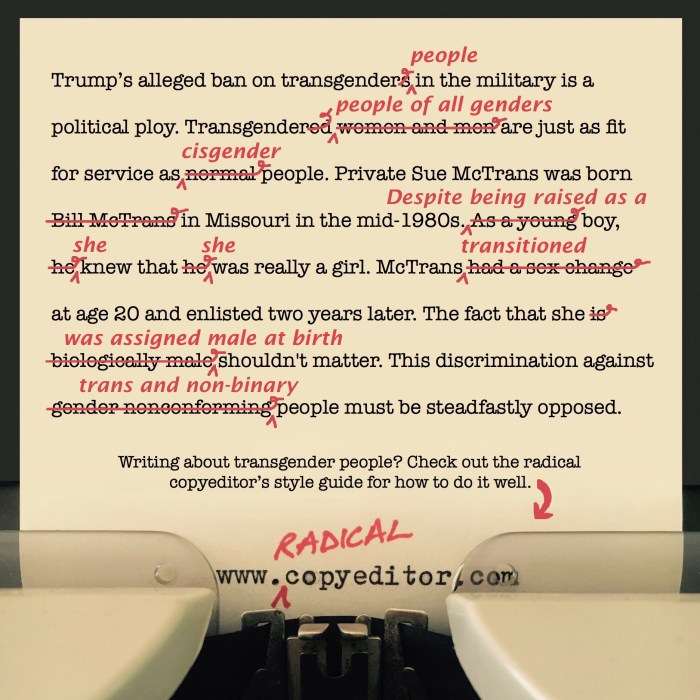
The Radical Copyeditor’s Style Guide for Writing About Transgender People

A paragraph of text that's been corrected to be more respectful of trans people
Full image description

Note: This style guide is regularly updated; the last revision was made May 18, 2021. You can also download this guide as a PDF and show your gratitude by making a donation!

Introduction (Read This First)

A style guide for writing about transgender people is practically an oxymoron. Style guides are designed to create absolutes—bringing rules and order to a meandering and contradictory patchwork quilt of a language. Yet there are no absolutes when it comes to gender. That’s why this is a radical copyeditor’s style guide. Radical copyediting isn’t about absolutes; it’s about context and care.

There are profound reasons for why the language that trans people use to describe ourselves and our communities changes and evolves so quickly. In many cultures, non-trans people have for centuries created the language that describes us, and this language has long labeled us as deviant, criminal, pathological, unwell, and/or unreal.

As trans people have fought for survival, we have also fought for the right to describe ourselves in our own language and to reject language that criminalizes, pathologizes, or invisibilizes us. Just as there is no monolithic trans community, there is also no one “correct” way to speak or write about trans people. Continue reading “The Radical Copyeditor’s Style Guide for Writing About Transgender People”

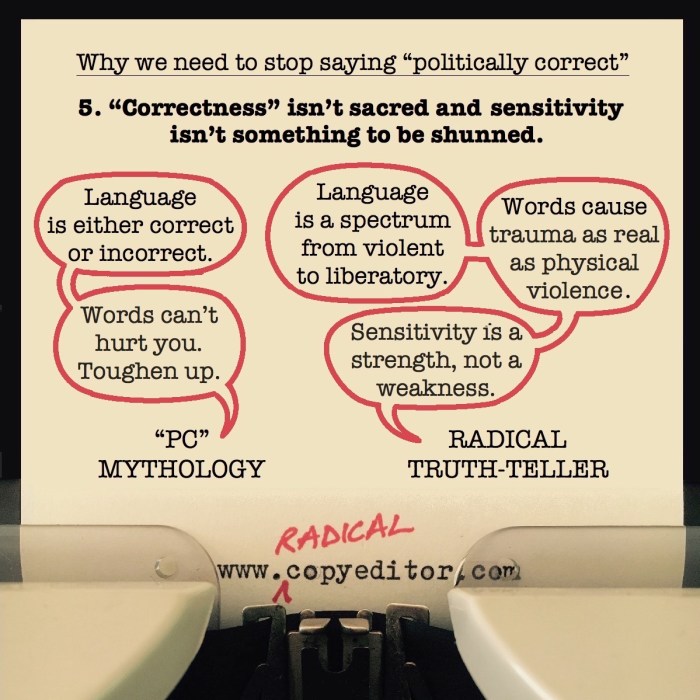
Part 5: It’s Time to Put “Political Correctness” Back Where It Belongs

"Correctness" isn't sacred and sensitivity isn't something to be shunned. Full description of pic below.

I follow the school of thought that the purpose of language conventions and standards is to help people communicate as effectively as possible across lines of difference, not that their purpose is to promote one “right” or “correct” way of speaking, writing, or being.

Holding “correctness” as sacred means valuing rules more than lives, homogeneity more than diversity, norms more than divergent experiences, and standards more than feelings. There is nothing sacred or inherently valuable about being “correct.” Here’s what’s sacred and valuable: respect, care, agency, empowerment, liberation.

So don’t ask yourself, “Am I being politically correct?”—rather, ask yourself, “Am I being respectful and caring toward the full range of human experience?” Continue reading “Part 5: It’s Time to Put “Political Correctness” Back Where It Belongs”

Part 4: There’s No Such Thing as Being “Oversensitive” over Violence, Trauma, and Oppression

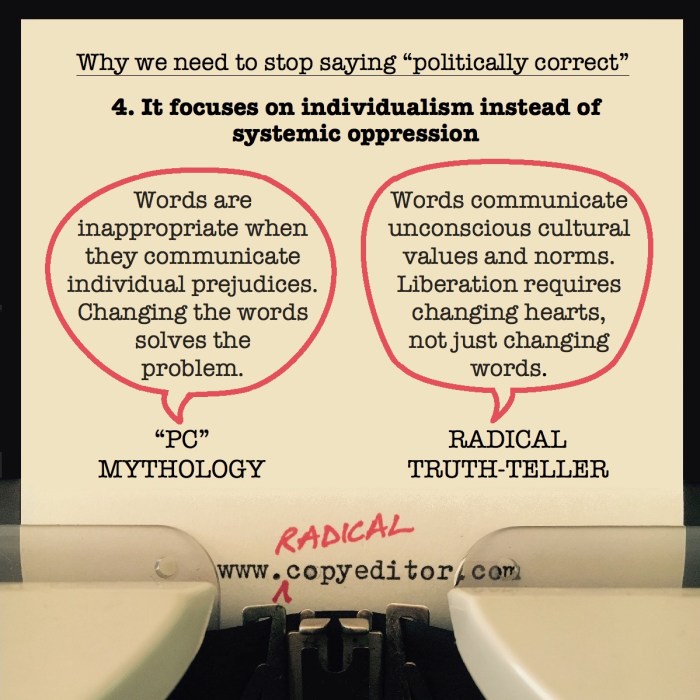
"Politically correct" focuses on individualism instead of system oppression. Full description of pic below.

One of the most common arguments by people who use the term “politically correct” is that people who say they are hurt by language are just being “oversensitive.”

Remember your friend whose boyfriend just died? Would you accuse your friend of being “oversensitive” at the mention of root beer floats, or sappy movies, or any number of other things that serve as a reminder of the loss? Most people wouldn’t, because your friend’s pain is culturally accepted as real and understandable.

Yet whenever someone’s pain goes against mainstream cultural norms, that’s when “oversensitive” comes out. Death is a pretty universal experience, but when it comes to things like sexism, racism, ableism, classism, and so on, not only is not everyone negatively impacted by these things, but by their very design some people suffer while others benefit—which creates an unconscious incentive to deny the pain experienced by people who are negatively impacted. Continue reading “Part 4: There’s No Such Thing as Being “Oversensitive” over Violence, Trauma, and Oppression”

Part 3: We Need to Care More about People than about Words

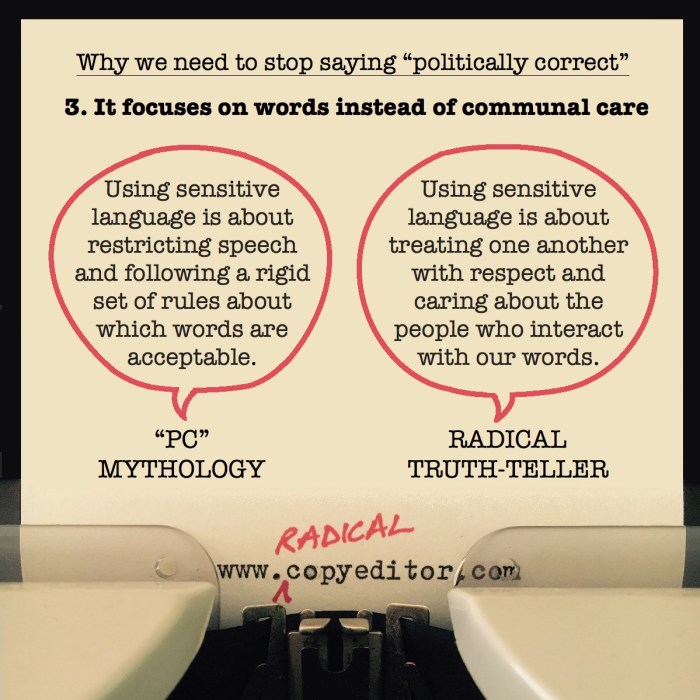
"Politically correct" focuses on words instead of communal care. Full description of pic below.

Let’s get one thing clear: words can hurt.

Imagine you have a friend whose boyfriend just died. Words are really powerful in this situation: they can help communicate your care and empathy for your friend, or they can hurt your friend and cause pain. If you were to say, for instance, that it was your friend’s fault that the boyfriend was dead, those words could have a deep impact—so deep that it might even drive your friend to suicide.

Far more minor word choices could be hurtful as well. For a long while after the tragedy, you would probably try to be sensitive and aware with your language so that you don’t unintentionally cause your friend further pain. You will probably choose not to gush about the guy you’re crushing out on right now. You may decide against inviting your friend to go see that new movie with a sappy love story in it. You might avoid certain topics because you know they will serve as a reminder of the loss.

You wouldn’t do these things because you’re trying to be “correct” or avoid “offending” your friend. You’d do these things because you care about your friend and you’re (hopefully) not a royal jerk. Continue reading “Part 3: We Need to Care More about People than about Words”

Part 2: Insensitive Language Isn’t “Offensive,” It’s Harmful

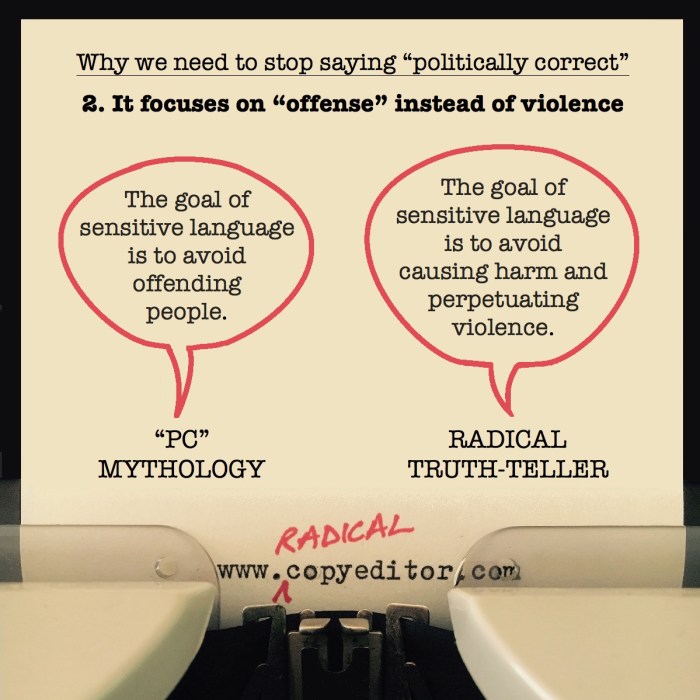
"Politically correct" focuses on "offense" instead of violence. Full description of pic below.

Language isn’t correct or incorrect, it’s a spectrum from violent to liberatory. When I strive to use language in ways that are inclusive of the full diversity of human experience, it’s not about being correct or avoiding offense. It’s about creating the opportunity for perspectives that have historically been squelched to shine. It’s about empowerment, and agency, and collective care. It’s about liberation.

The idea that avoiding “offending” people is the primary goal of sensitive language is inherently minimizing—it automatically calls up the idea that being offended is a result of being either overcritical or oversensitive, nothing more. It also squarely puts the burden of how language is experienced on the people who are hearing or reading it. It says that if you are offended by particular language, it’s your fault, not the speaker or author’s. Continue reading “Part 2: Insensitive Language Isn’t “Offensive,” It’s Harmful”

Part 1: Where Did “Politically Correct” Come From?

"Politically correct" is designed to be a slur, not a positive phrase. Full description of pic below.

Check it out: “politically correct” came into common usage in the United States in the 1940s and ’50s, when Socialists and Communists clashed over Stalin’s alliance with Hitler. Communist party doctrine was called the “correct” party line.

Jewish educator, author, and activist Herbert Kohl explains:

“The term ‘politically correct’ was used disparagingly to refer to someone whose loyalty to the [Communist party] line overrode compassion and led to bad politics. … [It] was meant to separate out Socialists who believed in equalitarian moral ideas from dogmatic Communists who would advocate and defend party positions regardless of their moral substance.”

People who were “politically correct” were people who said racism and genocide didn’t matter; people who claimed the party line was more important than actual people’s lives.

Who does that sound like to you? Continue reading “Part 1: Where Did “Politically Correct” Come From?”