Part 4: There’s No Such Thing as Being “Oversensitive” over Violence, Trauma, and Oppression

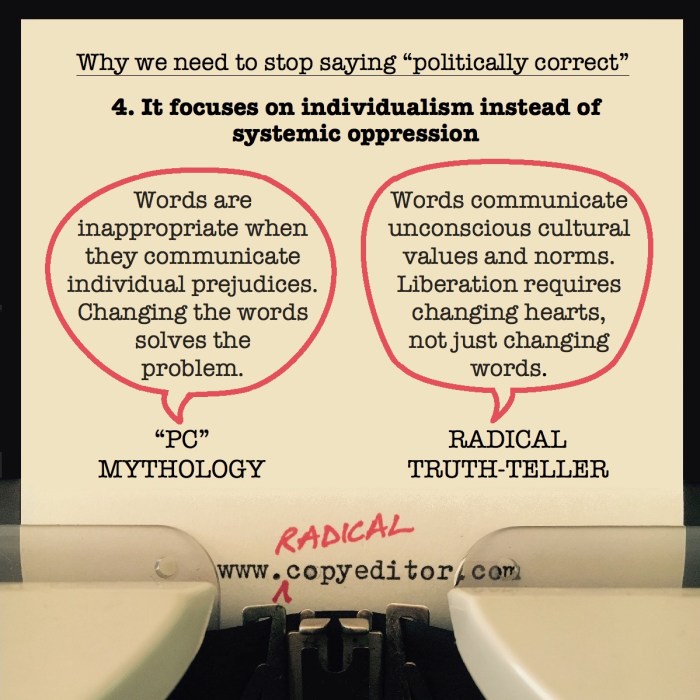
"Politically correct" focuses on individualism instead of system oppression. Full description of pic below.

One of the most common arguments by people who use the term “politically correct” is that people who say they are hurt by language are just being “oversensitive.”

Remember your friend whose boyfriend just died? Would you accuse your friend of being “oversensitive” at the mention of root beer floats, or sappy movies, or any number of other things that serve as a reminder of the loss? Most people wouldn’t, because your friend’s pain is culturally accepted as real and understandable.

Yet whenever someone’s pain goes against mainstream cultural norms, that’s when “oversensitive” comes out. Death is a pretty universal experience, but when it comes to things like sexism, racism, ableism, classism, and so on, not only is not everyone negatively impacted by these things, but by their very design some people suffer while others benefit—which creates an unconscious incentive to deny the pain experienced by people who are negatively impacted. Continue reading “Part 4: There’s No Such Thing as Being “Oversensitive” over Violence, Trauma, and Oppression”
Part 3: We Need to Care More about People than about Words

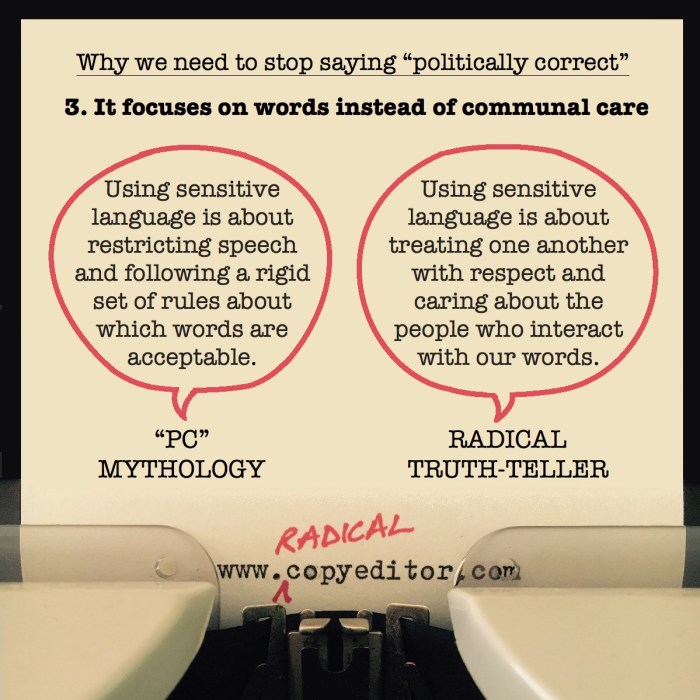
"Politically correct" focuses on words instead of communal care. Full description of pic below.

Let’s get one thing clear: words can hurt.

Imagine you have a friend whose boyfriend just died. Words are really powerful in this situation: they can help communicate your care and empathy for your friend, or they can hurt your friend and cause pain. If you were to say, for instance, that it was your friend’s fault that the boyfriend was dead, those words could have a deep impact—so deep that it might even drive your friend to suicide.

Far more minor word choices could be hurtful as well. For a long while after the tragedy, you would probably try to be sensitive and aware with your language so that you don’t unintentionally cause your friend further pain. You will probably choose not to gush about the guy you’re crushing out on right now. You may decide against inviting your friend to go see that new movie with a sappy love story in it. You might avoid certain topics because you know they will serve as a reminder of the loss.

You wouldn’t do these things because you’re trying to be “correct” or avoid “offending” your friend. You’d do these things because you care about your friend and you’re (hopefully) not a royal jerk. Continue reading “Part 3: We Need to Care More about People than about Words”

Part 2: Insensitive Language Isn’t “Offensive,” It’s Harmful

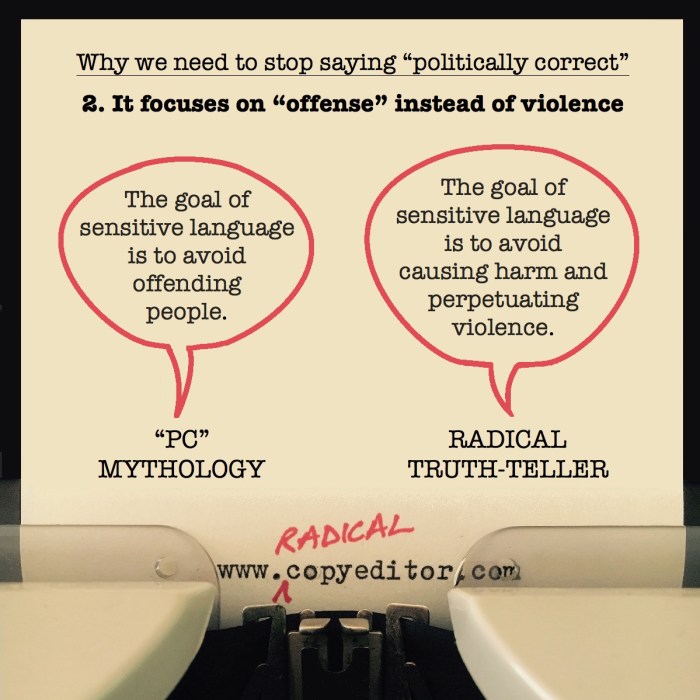
"Politically correct" focuses on "offense" instead of violence. Full description of pic below.

Language isn’t correct or incorrect, it’s a spectrum from violent to liberatory. When I strive to use language in ways that are inclusive of the full diversity of human experience, it’s not about being correct or avoiding offense. It’s about creating the opportunity for perspectives that have historically been squelched to shine. It’s about empowerment, and agency, and collective care. It’s about liberation.

The idea that avoiding “offending” people is the primary goal of sensitive language is inherently minimizing—it automatically calls up the idea that being offended is a result of being either overcritical or oversensitive, nothing more. It also squarely puts the burden of how language is experienced on the people who are hearing or reading it. It says that if you are offended by particular language, it’s your fault, not the speaker or author’s. Continue reading “Part 2: Insensitive Language Isn’t “Offensive,” It’s Harmful”

Part 1: Where Did “Politically Correct” Come From?

"Politically correct" is designed to be a slur, not a positive phrase. Full description of pic below.

Check it out: “politically correct” came into common usage in the United States in the 1940s and ’50s, when Socialists and Communists clashed over Stalin’s alliance with Hitler. Communist party doctrine was called the “correct” party line.

Jewish educator, author, and activist Herbert Kohl explains:

“The term ‘politically correct’ was used disparagingly to refer to someone whose loyalty to the [Communist party] line overrode compassion and led to bad politics. … [It] was meant to separate out Socialists who believed in equalitarian moral ideas from dogmatic Communists who would advocate and defend party positions regardless of their moral substance.”

People who were “politically correct” were people who said racism and genocide didn’t matter; people who claimed the party line was more important than actual people’s lives.

Who does that sound like to you? Continue reading “Part 1: Where Did “Politically Correct” Come From?”

“Correctness” Is Not the Goal, Liberation Is: Why We Need to Stop Saying “Politically Correct”

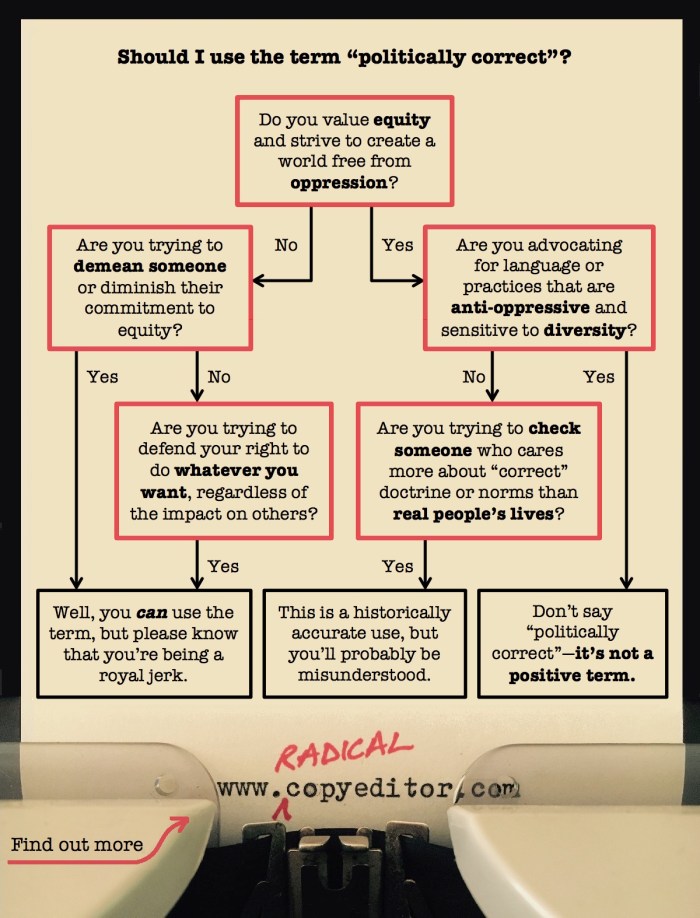
Flowchart for whether to use the term "politically correct." Full text description at bottom of page.

“Politically correct.” It’s a term used widely by everyone from right-wing pundits to preachers to diversity trainers, and pops up in myriad scenarios. It’s every bit as loaded as a baked potato, but nowhere near as delicious.

I’m here with a message about “politically correct” for folks like me who want to use language in ways that increase respect, rather than deepen divides. To quote the great Inigo Montoya, I do not think it means what you think it means. Continue reading ““Correctness” Is Not the Goal, Liberation Is: Why We Need to Stop Saying “Politically Correct””

The Spectrum of Language

spectrum of language rev
Full image description

United States mainstream culture promotes the idea that language is either “correct” or “incorrect” (in terms of grammar, spelling or pronunciation, word choice, and content). But language—along with everything else in this world—is so much more complex.

As a radical copyeditor and as someone who believes that words have incredible power for destruction, oppression, healing, liberation, and more, I understand language to exist on a spectrum from actively hateful to profoundly loving—and I strive to help people use language in the most life-affirming ways possible. Continue reading “The Spectrum of Language”